Εμφάνιση αναρτήσεων με ετικέτα Weapons. Εμφάνιση όλων των αναρτήσεων

Δευτέρα 21 Ιανουαρίου 2019

From Macedonian to Thessalian Tempi: from Rentina to Velika

Exhibition in the Museum of Byzantine Culture, Thessaloniki, Greece


The Museum of Byzantine Culture invites you cordially to the opening of the exhibition “From Macedonian to Thessalian Tempi: from Rentina to Velika” on Friday, 21 December at 21.00 in the wing of temporary exhibitions “Kyriakos Krokos” of the Museum
Five selected fortification sites from Macedonia and Thessaly are presented, all connected to each other by virtue of the fact that they were founded, constructed or renovated during the reign of Justinian I (527-565). 
These are: the castle of Rentina, the fortification wall of Cassandreia, the castle of Pydna, the castle of Platamon and the castle of Velika. The city of Thessaloniki is also presented, as an example of a walled metropolis. 
The exhibition places strong emphasis on the road networks that developed between the fortresses along with the economic and commercial relationships that were established in the region. The course of each site throughout time is presented in parallel. Furthermore, this exhibition is yet another opportunity for the Museum of Byzantine Culture to promote significant excavational discoveries from Central Macedonia that, until today, have been stored in its warehouses and not displayed to the public.


iron arrowheads, 13th-15th cent.
birds and monogram on poterry, 13th-14th cent.
Ceramic vessels for daily domestic use, 13-14th cent.

The castle of Kitros

lion on ceramic vessel. 12th cent.
 Silver Venetian and Serbian coins. Venetian grossi of  Doges JacopoTiepolo (1268-75), Francesco Dandolo (1329-39) and of the Serbian King Stefan Uros II Milutin (1282-1321)
 Bronze bracelets, 10th-12th cent.
 metal forks, arrowhead, knife, key, bone needle and stylus.10th-12th cent. - 
surgical tool (kyathiscomele) 6th cent.
 Lion on red ceramic vessel, 12th-14th cent.
male ring, 10th-12th cent.

The castle of Platamon

 Crossbow bolt, iron arrowheads, 14th-16th cent.
 Byzantine and Ottoman ceramic vessels, 14th-16th cent.
 Crossbow bolts and one arrowhead, 14th-15th cent.
 Marble parts of a church. 11th cent.
Stirrups, cannonballs and stone missiles for catapults. 14th-16th cent.


arrowheads, horseshoes. 7th-14th cent.
 spurs, horseshoes. 7th-14th cent.
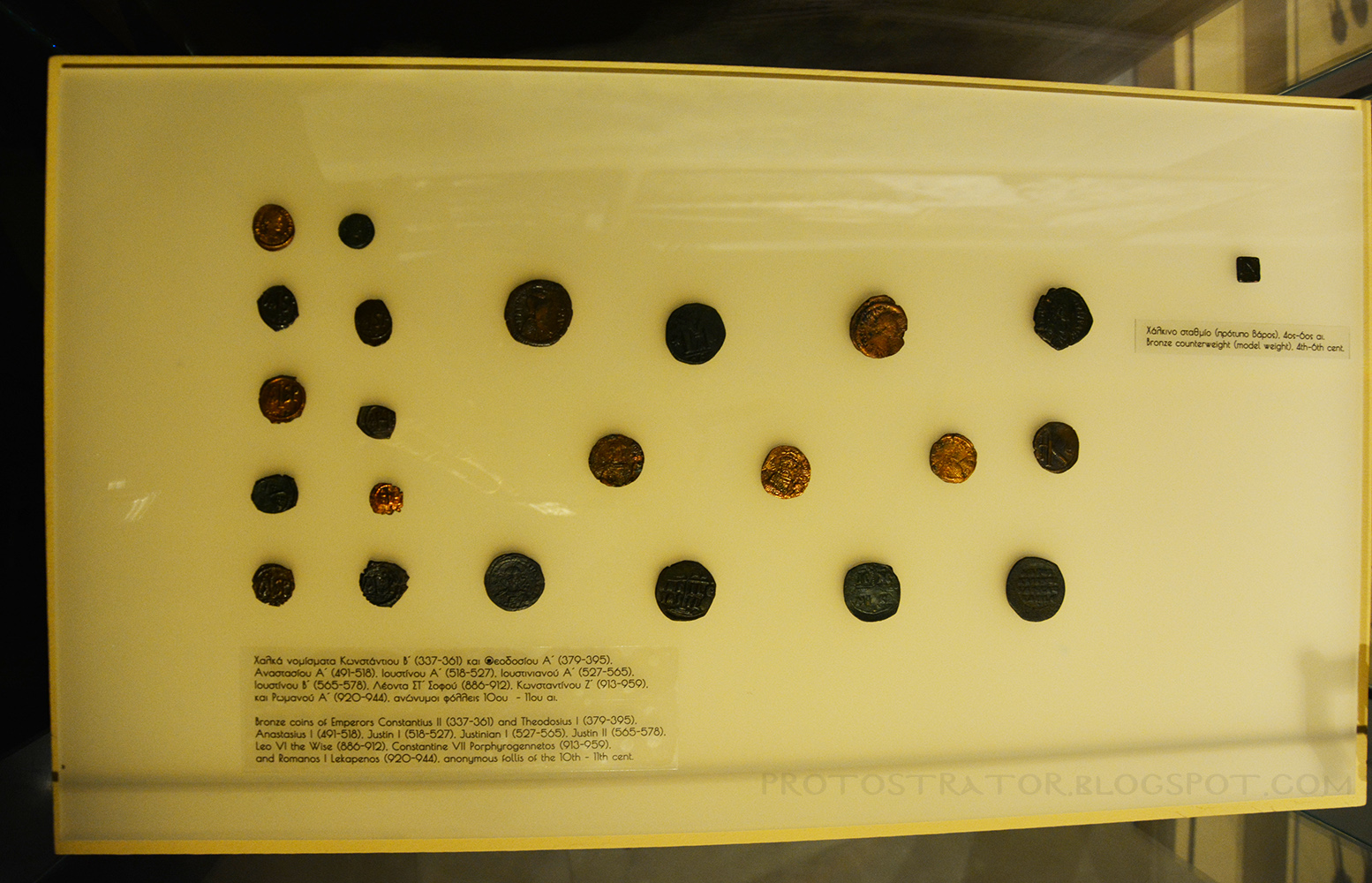
 various byzantine coins.4th-11th cent.
 iron knife blades and large knife. 10th-16th cent.
 Parts of a church. 10th-16th cent.
 Mosaic and frescoes. 5th-9th cent.
 Pseudosarcophagus marble cover. 11th cent.
Ceramic vessels. 12th cent.

The fortified city of Thessaloniki

 Bone parts of a composite bow. 13th-15th cent.
spurs, iron arrowheads. 13th-15th cent.
 Bone archer's rings. 14th-16th cent.
 crossbow bolts. 14th-15th cent.
 Crossbow bolts. 14th-15th cent.
iron arrowheads. 14th-15th cent.


Museum of Byzantine Culture
Wing of temporary exhibitions “Kyriakos Krokos
Exhibition duration: 21.12.18 – 31.5.2019
Opening hours: 9.00-16.00 Entrance free

Photos: Protostrator


Δευτέρα 28 Ιανουαρίου 2013

Soapstone Warriors (military saints in byzantine carved icons)


Sculpture was never really popular in byzantine art. The main reason for this was the close association of this form of art with the ancient pagan religion.
This does not mean in any way that sculpture ceased to exist with the prevalence of Christianity and the transformation of the ancient Roman empire to the medieval one (the Byzantine).
Reliefs, pannels, stattuetes and rarely statues were constantly produced for more than one thousand years.

An interesting category of sculpture artwork are the icons made of steatite, commonly known as "soapstone". They are mainly works of the 10th to 13th century (mainly the komnenian 11th-12th) and the majority of them depicts military saints.
It is probable that many of them belonged to officers and some were used as standards during litanies or battles.
The saints are depicted in detail, armed with arms of their time. This is really useful for the study of the byzantine military, since most of byzantine works of art tend to represent military saints with a more "antique" or "classical" style of arms and armor.


St.George. 11th cent. Steatite Icon. Vatopedi monastery, Athos, Greece
George is depicted as a cavalry officer.
He wears a klivanion cuirass (lamellar) with attached metal pteruges and a mail upper part-probably a hood.
His long leg protection (kampotouva) and tunick betray that he belongs to a cavalry regiment.
A spear, a long sword and an almond shaped shield are the saint's weapons.

St. Theodore Stratelates. 12th cent. Steatite
The saint is praying. The arms and armor are similar to those of St.George above. Note the pattern on the shield.
St.Demetrius. 12th cent. Steatite. (Louvre M.)
Demetrius here is an archer. Equipped with a composite bow, a spear and a round shield he wears a padded cuirass (zava) with attached pteruges.

St. Demetrius. 11th cent. Steatite.
The saint wears a chainmail coat and long boots, holds a sword and a shield is hanged by his shoulder.
St. Demetrius again. 11th cent. Steatite

 Saints on horseback. Demetrius on the left with a sword and a padded cuirass (similar to one above) and George spearing the dragon.
12th cent. Steatite (1.Kremlin, Moscow 2.MoBiA, New York)

St.Theodore, George and Demetrius. 12th cent. Steatite. Cherson
George in the center wears full lamellar protection, Theodore Stratelates a klivanion too and underneath mail, while Demetrius a chainmail. The first two hold a spear while Demetrius a remarkably long and broad sword. All of them have almond shaped shields.

The Arrest of Christ. 12th cent. Steatite
A soldiers lifts a mace (vardoukion).
The Crucifixion-12th cent. Steatite.
The centurion wears a headgear, a chainmail and an almond shaped shield.
Interrogation of Christ. 12th cent. Steatite. (Baltimore M.)
The officer on the left who strikes Jesus, does not wear armor but his uniform for the days of peace.


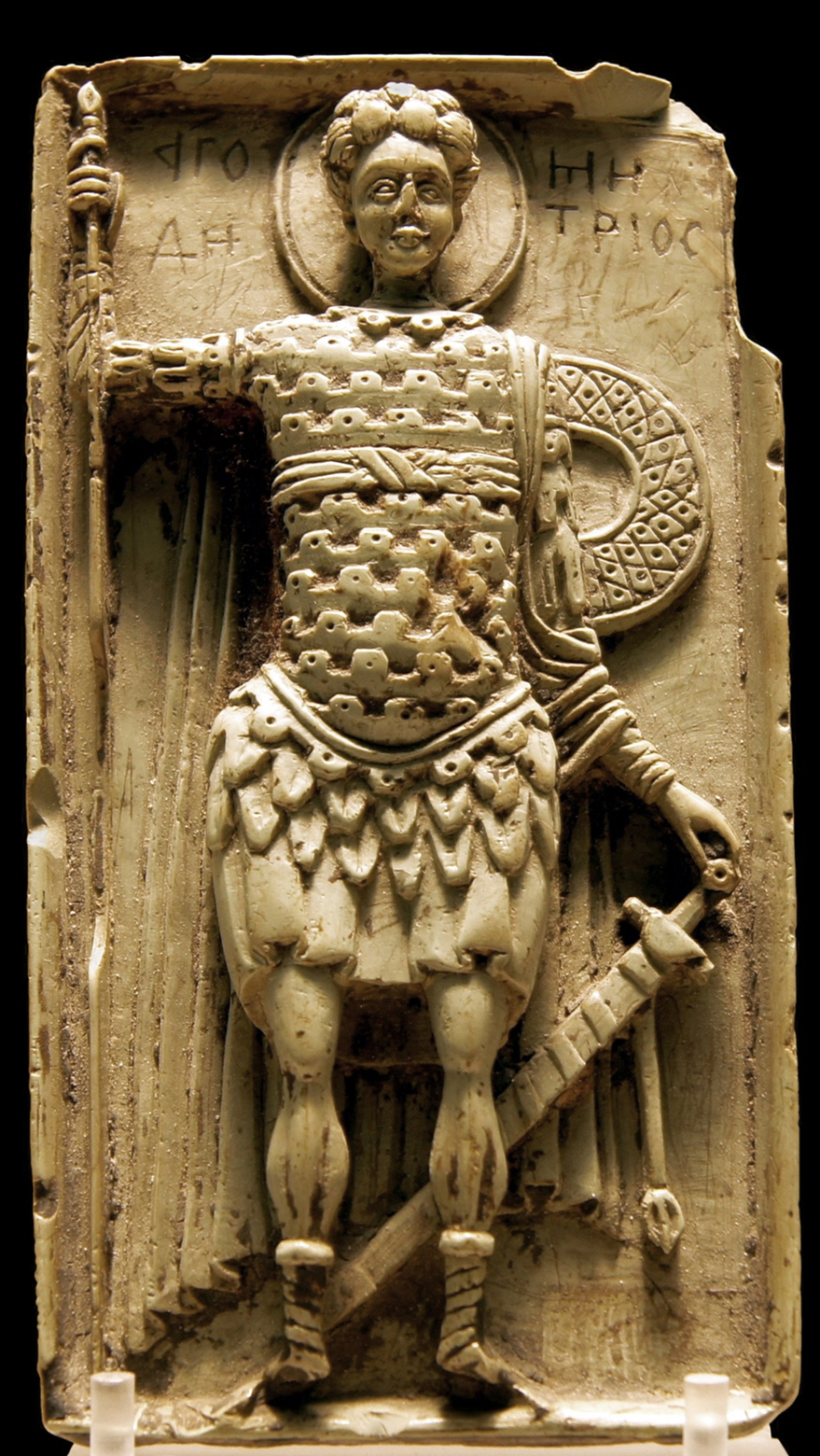
St.Demetrius wearing a lamellar cuirass (klivanion) with pteruges
He is holding a spear and a round shield -common in the 10th cent. 
By his right shoulder is hanged a broad sword in a decorated scabbard.
The cut-out panel at the base of the icon may have supported a standard that would have allowed the image to be carried in processions. 
The holes in the icon may mean that it was used as a cover for a book in the Latin West.
 Ivory icon 950-1000 (Metropolitan M.,New York)

The Louvre reliefs above belong to earlier and later periods and present a remarkable "classical" style. Arms and armor seem rather ancient than medieval.
Left and Right: The Harbavile Triptych, ivory panel, c.950
Center: St. Demetrius, steatite icon, 14th cent

Battle of the Old Testament- Full armed soldiers with round shields and kassidion helmets.
The Joshua ivory panel. mid 10th century (Metropolitan M, New York)


***


SOURCES:

1. Kalavrezou-Maxeiner, Byzantine Icons in Steatite, Vienna 1985
2. Christopher Walter, The warrior saints in byzantine art and tradition, Ashgate Publishing 2003


fragment of steatite icon from Traianoupolis, Greece. 12th cent